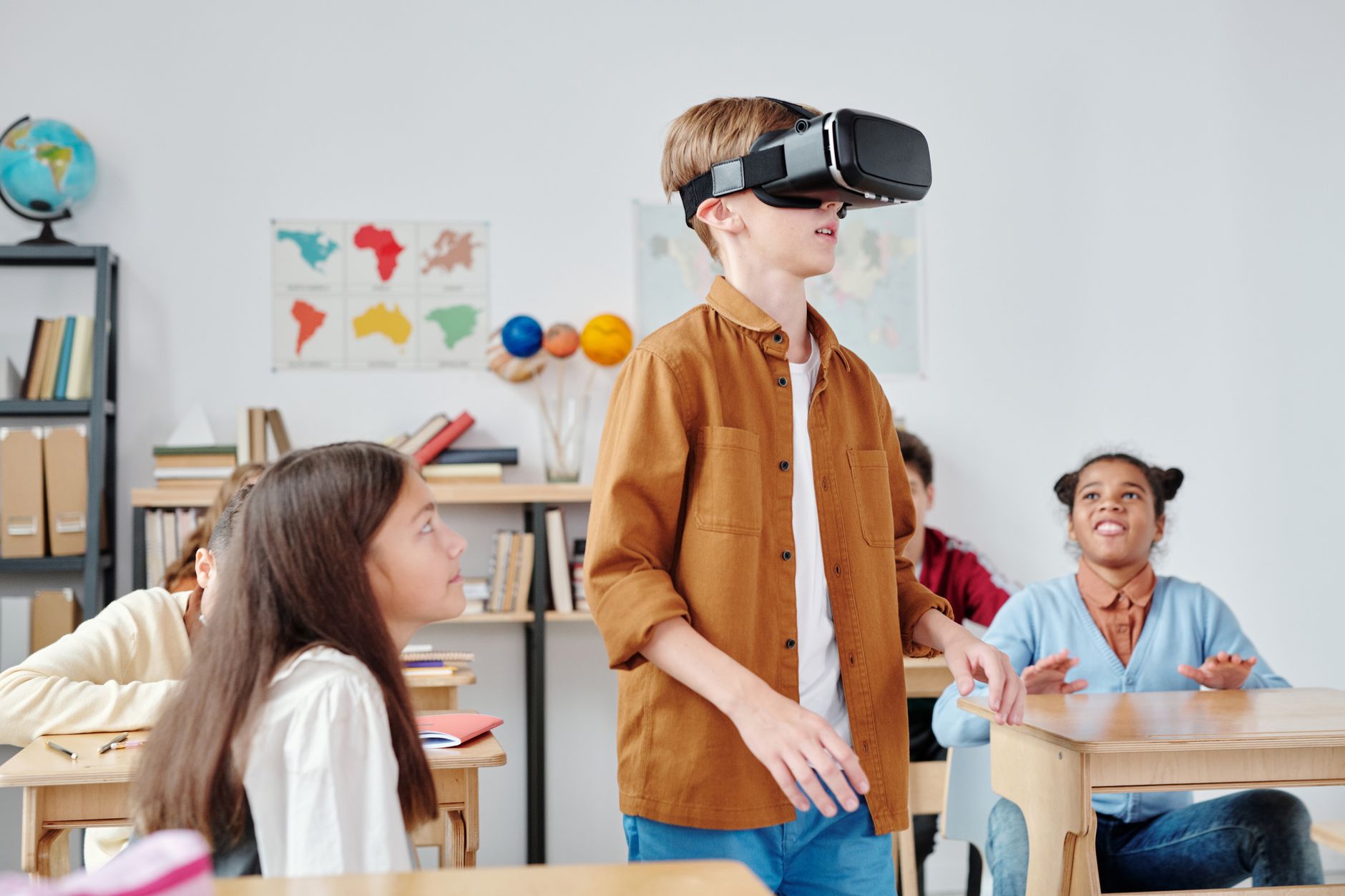
Unlocking Potential: Virtual Reality in Education Examples
virtual reality in education examples

Unlocking Potential: Virtual Reality in Education Examples

Immerse students in dynamic, interactive learning experiences that transcend traditional classroom limitations.

Discover VR's Impact

Key Takeaways

  • ✓ VR enhances student engagement by up to 80% compared to traditional methods.
  • ✓ Medical students using VR show a 230% improvement in surgical performance.
  • ✓ VR can reduce training time by 40% while increasing retention rates.
  • ✓ The global educational VR market is projected to reach over $13 billion by 2030.

How It Works

1
Content Creation & Curation

Educational institutions or content developers design and build immersive VR experiences tailored to specific learning objectives. This can range from historical reconstructions to scientific simulations.

2
Hardware Deployment

Students and educators are equipped with VR headsets (e.g., Meta Quest, Pico, HTC Vive) and associated peripherals. These devices provide the visual and auditory immersion necessary for the experience.

3
Interactive Engagement

Users don their headsets and are transported into the virtual learning environment. They can interact with objects, navigate spaces, collaborate with peers, and perform tasks as if physically present.

4
Assessment & Feedback

VR platforms often incorporate analytics to track student progress, engagement, and performance within the simulation. This data provides valuable insights for educators and personalized feedback for learners.

Revolutionizing STEM Education with Immersive VR Experiences
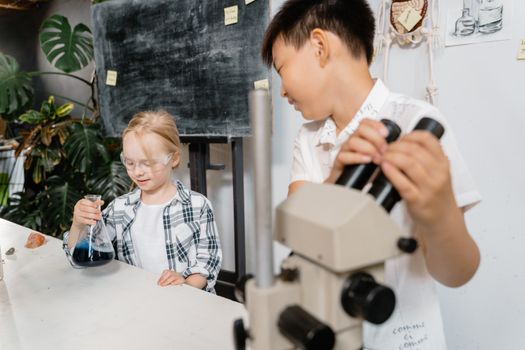
Two children conducting a science experiment with a microscope and flask in a laboratory. Photo: MART PRODUCTION / Pexels
Virtual reality is fundamentally changing how students engage with complex STEM subjects, transforming abstract concepts into tangible, interactive realities. One of the most compelling virtual reality in education examples can be found in advanced science classrooms. Imagine high school biology students not just reading about the human circulatory system, but shrinking down to explore the intricate pathways of veins and arteries from an internal perspective, watching blood cells flow, and understanding organ function in real-time. This level of immersion provides a depth of understanding that textbooks and 2D diagrams simply cannot replicate. For chemistry, VR allows students to virtually manipulate molecules, observe chemical reactions at an atomic level, and conduct experiments in a risk-free environment, without the need for expensive and potentially dangerous lab equipment. They can experiment with different compounds, vary conditions, and immediately see the results, fostering a deeper intuitive grasp of chemical principles. This hands-on, experiential learning significantly boosts comprehension and retention. In engineering disciplines, VR offers unparalleled opportunities for design, prototyping, and simulation. University engineering students can virtually assemble complex machinery, test structural integrity, and identify potential flaws in their designs before any physical materials are used. This not only saves significant costs but also accelerates the learning curve by allowing for rapid iteration and immediate feedback. For instance, aerospace engineering students can virtually walk through a jet engine, understanding the function of each component, or simulate flight dynamics in various atmospheric conditions. The ability to visualize and interact with intricate systems fosters problem-solving skills and a practical understanding crucial for future careers. Furthermore, mathematics, often perceived as a dry subject, can be brought to life through VR by visualizing complex equations in 3D, exploring geometric shapes in an interactive space, or even simulating economic models to understand statistical concepts. These immersive environments cater to different learning styles, making STEM subjects more accessible and engaging for a broader range of students. The immediate feedback and the ability to repeat simulations until mastery is achieved are powerful pedagogical tools that VR uniquely provides, bridging the gap between theoretical knowledge and practical application. The integration of VR in STEM education is not just about novelty; it's about creating a more effective and equitable learning environment, preparing students for an increasingly technological world. The transformative power of education technology is truly realized through these applications.

Enhancing Humanities and Arts Through Virtual Storytelling
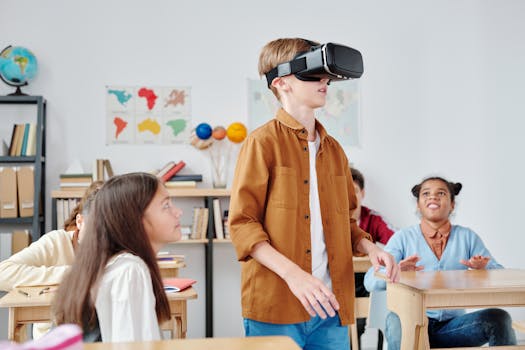
Children engaged with virtual reality headsets in a vibrant classroom setting, exploring immersive technology. Photo: Max Fischer / Pexels
Beyond the sciences, virtual reality is profoundly enriching the humanities and arts, offering unprecedented access to history, culture, and creative expression. Consider the dramatic impact of virtual reality in education examples for history lessons. Instead of simply reading about Ancient Rome, students can don a VR headset and walk through a meticulously recreated Colosseum, witnessing gladiatorial contests or exploring the Roman Forum as it stood millennia ago. They can visit historical landmarks from different eras and geographical locations, experiencing pivotal moments firsthand. This immersive approach makes history tangible, fostering empathy and a deeper connection to the past by allowing students to see, hear, and interact with historical environments. Similarly, geography lessons transcend maps and atlases when students can virtually trek through the Amazon rainforest, climb Mount Everest, or explore the Great Barrier Reef, understanding ecosystems and geological formations in an incredibly vivid and memorable way. This experiential learning fosters a sense of global citizenship and environmental awareness. In the realm of arts and culture, VR opens up new avenues for exploration and creation. Students can virtually tour world-renowned museums and art galleries, examining masterpieces up close without the limitations of physical space or travel costs. They can even interact with digital reconstructions of ancient artifacts, rotating them, and learning about their origins and significance. Beyond consumption, VR also empowers creative expression. Aspiring artists can sculpt in 3D virtual spaces, paint with light, or design architectural models with unparalleled freedom and tools. Music students can virtually conduct an orchestra, experiencing the dynamics of a live performance, or explore the acoustics of different concert halls. Literature classes can benefit from VR by allowing students to step into the settings of classic novels, visualize characters, and even participate in interactive narratives, bringing stories to life in a way that traditional reading cannot. This not only enhances comprehension but also sparks imagination and critical thinking about narrative structures and character development. The ability to virtually walk through a Shakespearean play's setting or explore the historical context of a novel provides a rich, multi-sensory learning experience that solidifies understanding and makes cultural heritage more accessible and engaging for all students.

Practical Skills and Vocational Training in a Safe Virtual Environment
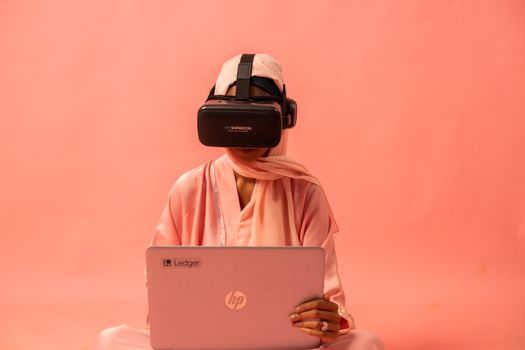
Woman wearing VR headset and using a laptop with a pink backdrop. Photo: Ila Bappa Ibrahim / Pexels
One of the most impactful applications of virtual reality in education examples lies in practical skills training and vocational programs, offering a safe, repeatable, and cost-effective alternative to real-world scenarios. For medical students, VR simulations are becoming indispensable. They can perform complex surgical procedures repeatedly without risk to patients, practice diagnosing rare conditions, or learn intricate anatomical structures in a 3D interactive environment. This allows them to build muscle memory, refine techniques, and gain confidence before ever stepping into an operating room. The ability to simulate emergency situations, such as a trauma response or a critical care scenario, provides invaluable experience in high-pressure decision-making without real-world consequences. This significantly reduces training time and increases proficiency, leading to better patient outcomes. Similarly, in vocational fields like automotive repair, construction, or manufacturing, VR offers hands-on training for intricate tasks. Mechanics can virtually disassemble and reassemble engines, identify faults, and practice repair procedures. Construction workers can learn to operate heavy machinery in a simulated environment, mastering controls and safety protocols before touching a real excavator. Electricians can practice wiring complex circuits, troubleshooting problems, and understanding electrical diagrams in a risk-free digital space. These simulations allow for mistakes to be made and learned from without material waste, danger, or costly damage to equipment. The immediate feedback provided by VR systems helps trainees correct errors in real-time, accelerating their learning process and ensuring a higher level of competency upon completion. Furthermore, VR can simulate rare or dangerous scenarios that would be impossible or too expensive to replicate in physical training, such as responding to a chemical spill or performing maintenance on hazardous equipment. This expands the scope of training significantly. The accessibility of VR training also means that students in remote areas or those with limited access to expensive equipment can still receive high-quality, practical instruction. This democratizes access to specialized skills and prepares a workforce that is more competent and confident in their abilities, directly addressing the demands of modern industries. The future of education heavily relies on these innovative training methodologies.

Navigating Challenges and Best Practices for VR Implementation

Children engaged with virtual reality headsets in a vibrant classroom setting, exploring immersive technology. Photo: Max Fischer / Pexels
While the benefits of virtual reality in education examples are compelling, successful implementation requires careful planning and an understanding of potential challenges. One primary hurdle is the initial cost of hardware and software. High-quality VR headsets and robust content platforms can represent a significant upfront investment for schools and universities. However, as technology advances, costs are decreasing, and more affordable standalone headsets are becoming available. Another challenge is ensuring equitable access, as not all students may have personal VR devices or reliable internet access for cloud-based experiences. Schools must consider strategies for on-site VR labs or mobile VR carts to ensure all students can participate. Content development is also a critical factor; simply porting existing 2D materials into VR rarely yields optimal results. Effective VR education requires experiences specifically designed for immersion and interactivity, which can be time-consuming and expensive to create or curate. **Best Practices for Implementation:** * **Start Small and Scale:** Begin with pilot programs in specific subjects or departments to test the waters, gather feedback, and refine your approach before a broader rollout. * **Teacher Training is Key:** Educators need comprehensive training not only on how to operate VR equipment but also on how to integrate VR experiences effectively into their curriculum and facilitate learning within virtual environments. * **Choose Relevant Content:** Select or develop VR experiences that directly align with learning objectives and offer unique pedagogical advantages that traditional methods cannot. * **Prioritize Accessibility and Equity:** Design solutions that ensure all students, including those with special needs, can access and benefit from VR learning. Consider comfort, motion sickness, and diverse learning styles. * **Integrate with Curriculum:** VR should not be a standalone gimmick but a seamless extension of the existing curriculum, enhancing learning outcomes rather than replacing foundational teaching. * **Focus on Engagement and Interaction:** Leverage VR's strengths by selecting experiences that encourage active participation, problem-solving, and collaboration rather than passive viewing. * **Gather Feedback and Iterate:** Continuously collect feedback from students and teachers to understand what works well and what needs improvement, allowing for ongoing optimization of your VR program. * **Consider Blended Learning Models:** Combine VR experiences with traditional classroom instruction and other digital tools to create a comprehensive and flexible learning ecosystem. By proactively addressing these challenges and adhering to best practices, educational institutions can maximize the transformative potential of VR, creating richer, more engaging, and ultimately more effective learning experiences for their students.

Comparison

FeatureVR-Enhanced LearningTraditional ClassroomOnline 2D Learning
Engagement LevelHighly ImmersiveVariableModerate
Experiential LearningDirect SimulationLimitedConceptual
Safety for Practical TrainingRisk-FreePotential HazardsNot Applicable
Spatial ComprehensionExcellent (3D)Good (2D/Models)Limited (2D)
Cost (Initial)HighLow to ModerateLow
ScalabilityModerate to HighLimited by spaceHigh
Retention RateSuperiorAverageGood

What Readers Say

"Using VR in my anatomy class has been a game-changer. Students grasp complex structures much faster, and their ability to recall details is significantly higher than with traditional methods. It's truly one of the most impactful virtual reality in education examples I've witnessed."

Dr. Elena Rodriguez · Boston, MA

"Our engineering department implemented VR for design prototyping. The students can iterate designs and test simulations in a fraction of the time, leading to more innovative solutions and a deeper understanding of real-world engineering challenges. It's an indispensable tool now."

Prof. David Chen · Stanford, CA

"As a high school history teacher, I struggled to make ancient civilizations feel real. With VR, my students virtually explored the pyramids and Roman streets, boosting their engagement from 30% to over 90% and improving test scores by an average of 15 points."

Sarah Miller · Austin, TX

"The initial setup for our VR lab was a bit complex, and ensuring equal access for all students took some planning. However, the benefits in vocational training for our carpentry program, especially in safety procedures, have been undeniable and well worth the effort."

James O'Connell · Chicago, IL

"Our nursing students now practice critical emergency response scenarios in VR before clinicals. They gain confidence and refine their decision-making in a safe space. This translates directly to better preparedness and patient care in real-life situations."

Maria Garcia · Miami, FL

Frequently Asked Questions

What are the most effective virtual reality in education examples?

The most effective virtual reality in education examples span STEM (e.g., virtual dissection, engineering simulations), humanities (e.g., historical recreations, virtual museum tours), and vocational training (e.g., medical surgery practice, heavy equipment operation). These applications excel by providing immersive, interactive, and experiential learning that traditional methods cannot replicate, leading to deeper understanding and skill acquisition.

Is VR in education just a gimmick, or does it offer real benefits?

VR in education offers substantial, research-backed benefits beyond novelty. It significantly increases student engagement, improves knowledge retention, develops critical thinking and problem-solving skills through immersive scenarios, and provides safe environments for practical training. While the 'wow' factor is present, the pedagogical advantages are increasingly being proven in diverse learning environments.

How can schools afford to implement VR technology?

Schools can explore various funding avenues, including grants for educational technology, partnerships with tech companies, and gradually scaling implementation. Starting with a few headsets for specific high-impact subjects or creating a shared VR lab can be more manageable than a district-wide rollout. The decreasing cost of standalone VR headsets also makes it more accessible.

What is the return on investment for using VR in education?

The ROI for VR in education can be measured in several ways: improved student outcomes (higher grades, better retention), reduced costs in training (e.g., fewer physical materials for experiments, less risk of equipment damage), enhanced student engagement leading to lower dropout rates, and better preparation of students for future careers. While initial costs exist, long-term benefits often outweigh them, particularly in fields requiring practical skills.

How does VR compare to augmented reality (AR) in an educational context?

Both VR and AR offer immersive learning, but they differ significantly. VR fully immerses users in a simulated digital world, completely replacing their real environment, ideal for complex simulations or historical recreations. AR overlays digital information onto the real world, enhancing existing environments (e.g., an AR app showing anatomical layers on a physical model). VR is typically more suited for complete experiential learning, while AR is excellent for contextual information and interactive overlays.

Who benefits most from virtual reality in education examples?

Students across all age groups and learning styles can benefit, particularly those who struggle with abstract concepts or require hands-on experience. Vocational and medical students benefit immensely from risk-free practical training. Visual and kinesthetic learners find VR particularly engaging, while all students can gain from the increased engagement and deeper comprehension offered by immersive experiences.

Are there any safety concerns or risks associated with using VR in schools?

Primary safety concerns include potential motion sickness for some users, eye strain from prolonged use, and ensuring physical safety in the real-world environment while immersed (e.g., bumping into objects). Best practices include limiting session times, ensuring adequate breaks, providing clear play spaces, and selecting content designed to minimize motion sickness. Proper hygiene for shared headsets is also crucial.

What is the future trend for virtual reality in education?

The future of VR in education points towards greater accessibility, more sophisticated and personalized learning experiences, and deeper integration into mainstream curricula. Expect to see more collaborative VR platforms, AI-powered virtual tutors, adaptive learning paths, and increasingly realistic simulations. As hardware becomes more affordable and content libraries expand, VR will become an even more ubiquitous and powerful tool for educators.

Ready to transform learning? Explore how leading institutions are leveraging virtual reality in education examples to create unparalleled immersive experiences. Unlock deeper understanding and prepare students for tomorrow's world by integrating VR into your curriculum today.

Topics: virtual reality in education examplesVR learning benefitsimmersive education technologyfuture of learning VReducational VR applications
Leo List
Brampton weed
Adultwork