
Smart Choices: Buy Educational Software for Kids
buy educational software for kids

Smart Choices: Buy Educational Software for Kids

Unlock your child's potential with carefully selected educational software designed for engaging and effective learning.

Find the Best Software

Key Takeaways

  • ✓ Educational software can significantly enhance cognitive skills and academic performance.
  • ✓ Interactive learning platforms foster engagement and make complex subjects accessible.
  • ✓ Personalized learning paths cater to individual learning styles and paces.
  • ✓ Choosing age-appropriate and curriculum-aligned software is crucial for optimal benefits.

How It Works

1
Identify Learning Goals

Before you buy educational software for kids, determine what skills or subjects your child needs to develop. Consider their age, interests, and current academic level.

2
Research and Compare Options

Explore various software categories like math, reading, coding, or creativity. Look for reputable publishers, read reviews, and check for curriculum alignment.

3
Try Demos or Free Trials

Many educational software providers offer free trials or demo versions. This allows your child to experience the software firsthand and ensures it's a good fit before purchase.

4
Integrate into Routine

Once purchased, integrate the software into your child's daily or weekly routine. Monitor their progress and provide support to maximize the learning experience.

The Transformative Power of Children's Learning Apps

Two children focused on using a tablet indoors, engaging with technology for learning and play. Photo: Alex Green / Pexels
In an increasingly digital world, the landscape of education has undergone a profound transformation. Gone are the days when learning was confined solely to textbooks and classrooms. Today, parents and educators have an incredible array of tools at their disposal, and among the most impactful are children's learning apps and educational software. When you decide to buy educational software for kids, you're not just purchasing a product; you're investing in a dynamic, interactive, and often personalized learning experience that can profoundly shape your child's cognitive development, academic success, and lifelong love for learning. Educational software excels at making complex concepts accessible and engaging. For instance, a child struggling with fractions might find abstract textbook explanations challenging. However, an interactive math game that visually represents fractions through animated pizzas or virtual building blocks can make the concept concrete, understandable, and even fun. This gamified approach to learning is a cornerstone of effective educational software. It leverages children's natural inclination towards play, turning what might otherwise be a tedious task into an exciting challenge. Rewards, progress tracking, and immediate feedback loops inherent in these programs keep children motivated and provide a sense of accomplishment, encouraging them to persist and explore further. Furthermore, the adaptability of modern educational software is a significant advantage. Many platforms employ adaptive learning algorithms that adjust the difficulty level and content based on a child's individual performance. If a child masters a concept quickly, the software progresses them to more advanced material. Conversely, if they struggle, it offers additional practice, alternative explanations, or different approaches until mastery is achieved. This personalized learning path is something traditional classroom settings often struggle to provide consistently, given the diverse needs of many students. It ensures that every child learns at their optimal pace, preventing boredom for fast learners and frustration for those who need more time. This tailored experience makes the decision to invest in educational resources like software a strategic move for any parent. Beyond core academic subjects, educational software also plays a crucial role in developing essential 21st-century skills. Many programs focus on critical thinking, problem-solving, creativity, and digital literacy. Coding games, for example, introduce computational thinking from a young age, fostering logical reasoning and sequential thought. Art and music software can unleash a child's creative potential, providing digital canvases and instruments that are both forgiving and inspiring. Even seemingly simple puzzle games can hone spatial reasoning and pattern recognition. The ability to navigate digital interfaces, understand basic programming logic, and leverage technology for creative expression are invaluable skills in today's world. By carefully selecting and integrating educational software, parents can provide their children with a head start in developing these crucial competencies, preparing them for future academic and professional challenges. The sheer breadth of subjects and skills covered by educational software means there's something for every child, catering to diverse interests and learning styles. Whether your child is a budding scientist, a future artist, or a language enthusiast, the right software can ignite their passion and provide a powerful platform for exploration and growth. This makes the process of deciding to buy educational software for kids a journey into unlocking their full potential.

Navigating the Options: What to Look for in Educational Software

A mother and her daughter bonding while using a digital tablet indoors. Photo: Nicola Barts / Pexels
With the vast ocean of educational software available, knowing where to start can feel overwhelming. The key to making a successful purchase when you decide to buy educational software for kids lies in understanding what factors truly matter and how to evaluate different options effectively. It's not just about finding the most popular app, but rather the one that best aligns with your child's specific needs, your family's values, and your educational goals. Firstly, age-appropriateness is paramount. Software designed for a 10-year-old will likely bore a 5-year-old or overwhelm a 7-year-old. Pay close attention to the recommended age range provided by the developer, but also use your judgment based on your child's individual developmental stage and prior knowledge. Content should be challenging enough to stimulate growth but not so difficult that it leads to frustration. The user interface (UI) should also be intuitive and accessible for the target age group, allowing children to navigate independently without constant adult intervention. Look for clear icons, simple instructions, and responsive controls. Beyond age, consider the educational value and curriculum alignment. Does the software focus on rote memorization, or does it encourage deeper understanding, critical thinking, and problem-solving? Ideally, the software should align with recognized educational standards (like Common Core in the US, where applicable) or provide skills that are foundational to academic success. Read reviews from other parents and educators, and look for endorsements from educational organizations. Many reputable software providers will highlight how their programs support specific learning outcomes. When you buy educational software for kids, you're looking for genuine learning, not just digital babysitting. Another critical consideration is engagement and replayability. Children quickly lose interest if software is repetitive, lacks novelty, or doesn't offer a sense of progression. Look for programs that incorporate varied activities, dynamic challenges, and opportunities for creative expression. Software that offers multiple levels, customizable characters, or user-generated content can significantly extend its lifespan and maintain a child's interest over time. A good educational game doesn't just teach; it captivates. Furthermore, safety and privacy are non-negotiable. Ensure the software is free from inappropriate content, intrusive advertisements, and features that could expose your child to online risks. Check the developer's privacy policy to understand how personal data is collected, stored, and used. Opt for programs that are COPPA compliant (Children's Online Privacy Protection Act) and prioritize a safe, ad-free environment. Parent control features, such as time limits or progress reports, are also highly desirable, giving you peace of mind and the ability to manage your child's screen time effectively. Lastly, consider the cost model. Is it a one-time purchase, a subscription service, or a freemium model with in-app purchases? Evaluate the long-term value against the price. Sometimes, a slightly higher upfront cost for a comprehensive, ad-free experience is more beneficial than a 'free' app riddled with distractions and hidden costs. By carefully weighing these factors, you can make an informed decision and confidently buy educational software for kids that will truly enrich their learning journey.

Unlocking Potential: STEM Software and Creative Learning Tools
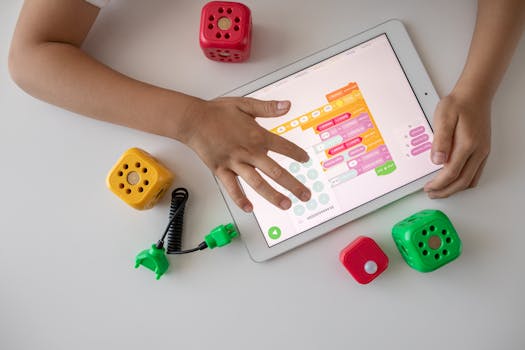
Child using digital tablet for coding education alongside colorful toy blocks. Photo: Robo Wunderkind / Pexels
The modern educational landscape emphasizes not just foundational literacy and numeracy, but also critical skills in STEM (Science, Technology, Engineering, and Mathematics) and creative arts. When you decide to buy educational software for kids, you have an unparalleled opportunity to introduce these vital subjects in an engaging and accessible manner, often years before they are formally introduced in schools. This early exposure can spark lifelong interests and lay a strong foundation for future academic and career pursuits. STEM software, in particular, has seen tremendous innovation, transforming abstract scientific principles and complex mathematical concepts into interactive, hands-on experiences. For instance, virtual science labs allow children to conduct experiments safely, manipulating variables and observing outcomes without the mess or danger of real-world chemicals. Robotics simulation software teaches basic engineering principles and coding logic, enabling children to design and program virtual robots to perform tasks. These types of programs demystify STEM fields, making them less intimidating and more exciting. Coding software for kids is a prime example of how educational tools are preparing the next generation. Platforms like Scratch, Tynker, or CodeMonkey use visual, block-based programming languages that are easy for young children to grasp. They learn fundamental computational thinking skills – sequencing, loops, conditionals – by creating their own games, animations, and interactive stories. This not only develops logical reasoning and problem-solving but also fosters creativity and perseverance. Learning to code isn't just about becoming a programmer; it's about learning how to think systematically and approach challenges with a structured mindset. Similarly, mathematics software has evolved beyond simple drills. Modern math apps often incorporate adaptive learning, game-based scenarios, and visual aids to teach concepts from basic arithmetic to algebra and geometry. They can identify areas where a child struggles and provide targeted practice, turning potential weaknesses into strengths. The interactive nature of these programs means children are actively doing math, not just passively observing it, leading to deeper comprehension and retention. Engaging with these tools helps children build confidence and a positive attitude towards subjects that are often perceived as difficult. It's about making learning an adventure, not a chore, which is a key benefit when you buy educational software for kids. Beyond STEM, creative learning tools offer immense value. Art software, music composition apps, and digital storytelling platforms provide children with powerful mediums for self-expression and imaginative play. A child can compose their own melodies, illustrate their own stories, or design intricate digital artwork, all within a guided and supportive environment. These tools not only hone artistic skills but also encourage innovation, critical thinking, and emotional expression. They provide a safe space for experimentation, where mistakes are part of the learning process, not failures. For children who might not thrive in traditional academic settings, creative software can be a lifeline, revealing hidden talents and building self-esteem. The synergy between STEM and creativity is also increasingly recognized, with many programs blending both. For example, designing a video game requires both coding logic and artistic design. By offering a diverse range of educational software, parents can ensure their children receive a well-rounded digital education that nurtures both their analytical and creative faculties. This holistic approach to learning is one of the most compelling reasons to explore various educational platforms and make informed choices to buy educational software for kids.

Common Mistakes to Avoid When Buying Educational Software

A young girl intensely focused on a tablet indoors, depicting concentration. Photo: Ryan Delfin / Pexels
Making the right choice when you decide to buy educational software for kids can be transformative, but it's also easy to fall into common traps. Avoiding these pitfalls will ensure your investment genuinely benefits your child's learning journey. Here are some mistakes to watch out for: * **Ignoring Age-Appropriateness:** One of the biggest errors is purchasing software that is either too advanced or too simplistic for your child's age and developmental stage. Software that's too hard leads to frustration and disengagement, while software that's too easy offers no real learning challenge. Always cross-reference the recommended age range with your child's specific needs and abilities. * **Prioritizing Entertainment Over Education:** Many apps are marketed as 'educational' but offer minimal learning value, focusing instead on flashy graphics and repetitive gameplay. While engagement is important, ensure the core mechanics and content genuinely teach new skills or reinforce existing knowledge. Look for clear learning objectives and evidence of pedagogical design. * **Skipping Free Trials/Demos:** Don't buy without trying. Most reputable educational software offers a free trial period or a demo version. This is your chance to see if your child actually enjoys the software, if the interface is intuitive for them, and if it meets your expectations for educational quality. A child's direct interaction is the best litmus test. * **Overlooking Privacy and Safety Features:** In the digital age, child safety is paramount. Failing to investigate the privacy policy, data collection practices, and the presence of in-app purchases or ads can lead to unwanted surprises. Always opt for software that is COPPA compliant and offers a secure, ad-free environment. * **Not Researching Reviews and Reputation:** Don't rely solely on the developer's marketing. Read independent reviews from other parents, educators, and reputable tech review sites. These provide valuable insights into the software's effectiveness, potential drawbacks, and overall user experience. A strong reputation often indicates quality and reliability. * **Buying Too Many Programs at Once:** It can be tempting to purchase a variety of software covering different subjects. However, overwhelming a child with too many options can lead to decision fatigue and fragmented learning. Start with one or two high-quality programs that address specific learning goals, and allow your child to master them before introducing new ones. * **Neglecting Parent Involvement:** Educational software is a tool, not a substitute for parental engagement. A common mistake is to simply hand over the device and expect miracles. Parents should actively participate, even if it's just by asking questions about what the child is learning, celebrating successes, or offering help when needed. This reinforces the learning and strengthens the parent-child bond. By being mindful of these common missteps, you can make more informed decisions and ensure that when you buy educational software for kids, it truly serves its intended purpose of enhancing their learning and development.

Comparison

FeatureABCmouseOsmoProdigy Math GameCodeSpark Academy
Ages2-83-121st-8th Grade5-9
Subjects CoveredReading, Math, Art, ScienceSTEM, Art, Reading, CodingMathCoding, Logic
Learning StyleCurriculum-based, GuidedHands-on, InteractiveGame-based, AdaptivePlay-based, Problem-solving
Parent Controls
Free Trial Available✗ (starter kits)
Subscription ModelMonthly/AnnualOne-time kit + optional subscriptionFreemium (paid membership for full features)Monthly/Annual
Offline PlayLimitedYes (with physical pieces)NoYes

What Readers Say

"We decided to buy educational software for our 5-year-old to help with reading, and the app we chose has been phenomenal. Her phonics skills have improved dramatically, and she actually looks forward to her 'learning time' on the tablet. It's truly engaging."

Sarah P. · Austin, TX

"Finding quality educational software for kids was a top priority. We found a great STEM program that has our son excited about coding. He's creating his own mini-games now, which is incredible to see. Highly recommend looking into these options."

Mark T. · Seattle, WA

"My daughter was struggling with math concepts, so we looked to buy educational software for kids. The interactive math game we got made a huge difference; her confidence in school has soared, and her grades reflect the improvement. It's been a game-changer."

Jessica L. · Orlando, FL

"The educational software we purchased for our twins offers great content, though sometimes the in-app purchases can be a bit aggressive. Overall, the learning benefits outweigh this, and they're learning a lot about history in a fun way."

David R. · Denver, CO

"As an educator, I always recommend parents buy educational software for kids. We use several programs in our homeschooling curriculum, and the ability to customize lessons and track progress is invaluable. It truly personalizes the learning experience."

Emily C. · Boston, MA

Frequently Asked Questions

What age is best to start using educational software?

Children as young as two or three can begin with highly interactive, visually driven educational software focusing on basic concepts like shapes, colors, and letters. However, the most significant academic benefits typically emerge for children aged 4-12, as they engage with more complex subjects like reading, math, and coding. It's crucial to select age-appropriate content to ensure engagement and effective learning.

Is screen time from educational software harmful for children?

When managed appropriately, screen time spent on high-quality educational software can be beneficial. The key is moderation, quality of content, and active engagement. Unlike passive entertainment, educational software often requires interaction and critical thinking. Pediatric guidelines suggest limiting recreational screen time, but often make exceptions for interactive learning. Balance digital learning with physical play and other activities.

How can I ensure the software is truly educational and not just entertainment?

Look for clear learning objectives, adaptive learning features, and content aligned with educational curricula. Read reviews from parents and educators, and check for endorsements from reputable educational organizations. The best educational software balances engaging gameplay with substantive learning content, fostering critical thinking and problem-solving skills rather than just rote memorization or passive consumption.

What is the typical cost to buy educational software for kids?

The cost varies widely. Some excellent apps are free with optional in-app purchases, while others are one-time purchases ranging from $5 to $50. Many comprehensive platforms operate on a subscription model, costing $10-$30 per month or $50-$200 annually. Consider the value, features, and how many children will use it when evaluating the cost-effectiveness.

How does educational software compare to traditional learning methods?

Educational software complements, rather than replaces, traditional methods. It offers interactive, personalized, and engaging experiences that can reinforce classroom learning, provide targeted practice, and introduce new concepts in a dynamic way. It excels at adaptive learning, immediate feedback, and making abstract ideas concrete, which can be challenging in a large classroom setting.

Which subjects are best taught through educational software?

Educational software is highly effective across a broad range of subjects. It particularly excels in areas like math (through interactive problem-solving), reading and phonics (with engaging stories and games), coding (through visual programming), and science (with virtual experiments and simulations). Creativity and critical thinking skills are also well-developed through art, music, and puzzle-based software.

Are there any risks associated with using educational software?

The primary risks involve excessive screen time, exposure to inappropriate content, or privacy concerns if the software isn't reputable. To mitigate these, choose software with strong parent controls, read privacy policies carefully, and ensure it's COPPA compliant. Always supervise children's online activities and balance digital learning with offline experiences to avoid potential negative impacts.

What future trends can I expect in educational software for kids?

Future trends include increased integration of Artificial Intelligence for more personalized and adaptive learning paths, augmented and virtual reality experiences for immersive education, and greater emphasis on developing soft skills like emotional intelligence and collaboration. Expect more cross-platform compatibility and seamless integration with smart home devices, making learning even more ubiquitous and interactive.

Empower your child's future by making informed decisions to buy educational software for kids. Explore the diverse world of interactive learning tools and unlock their full potential today. Start their journey toward a brighter, more engaging educational experience.

Topics: buy educational software for kidschildren's learning appseducational games for kidsSTEM software for childrenonline learning tools for kids
Leo List
Brampton weed
Adultwork EstrelaBet Vai de Bet R7 Bet Betão Galera Bet Rainbet Bet9ja Shop SportyBet BetKing Sisal Loto Foot Hollywoodbets YesPlay Odibets RushBet Jugabet BetWarrior BetCity MSport betPawa Fortebet